Today I received a phone call that completely caught me off guard.
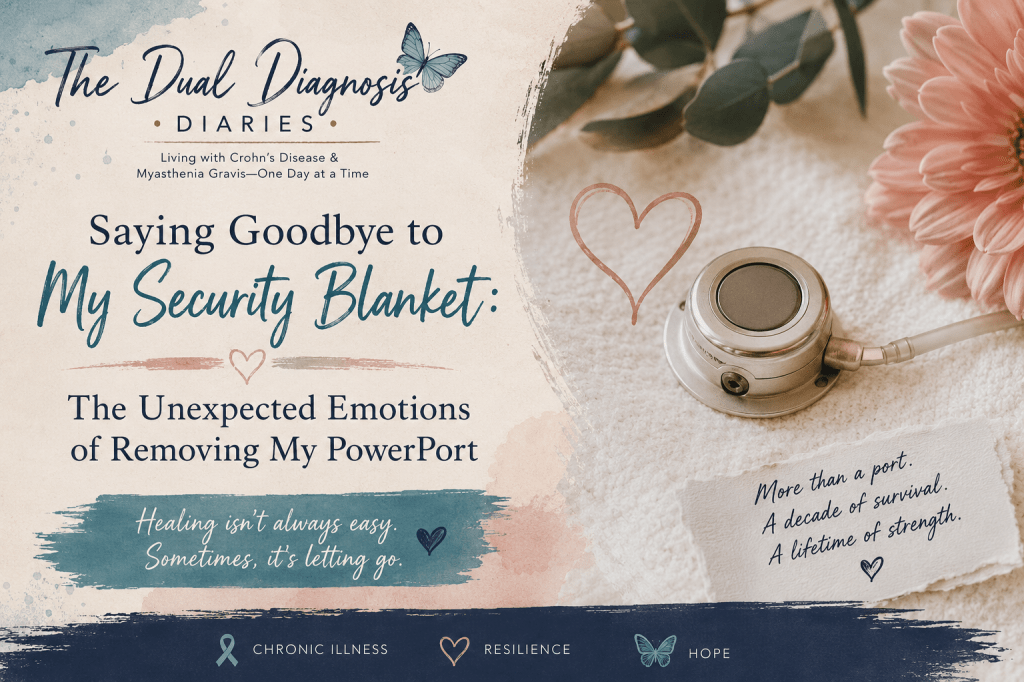
The UCLA Radiology Department called to schedule the removal of my PowerPort.
At first, I was confused.
Then I was shocked.
Then I was sad.
The order had apparently come from my neurologist, and while I understood the reasoning, it wasn’t something I remember discussing during my appointment on Monday. Hearing a stranger call to schedule the removal of something that has been part of my body for more than a decade felt surreal.
After taking some time to process it, I agreed to move forward with the procedure. My surgery is now scheduled for June 26th.
Yet even after scheduling it, I couldn’t stop asking myself:
Why am I so attached to my port?
More Than a Medical Device
My PowerPort was originally placed more than ten years ago when I was receiving chemotherapy treatments for Crohn’s Disease.
For years, it was more than a lifeline.
Week after week, treatment after treatment, my port was there.
Then one day, I made the decision to stop treatment.
For me, the side effects had become too much. Looking back, it was one of the best decisions I ever made for my quality of life.
I haven’t received chemotherapy in nearly six years.
Yet my port remained.
Not because I needed it for treatment.
Not because I used it regularly.
But because knowing it was there brought me comfort.
I don’t use my port for Rystiggo because that medication is administered through injections in my abdomen.
I have chosen to manage my Crohn’s holistically and have no plans to return to the medications I once relied upon.
From a medical perspective, removing the port makes perfect sense.
So why was I struggling with the decision?
Because the port stopped being about treatment years ago.
My Security Blanket
Anyone who has spent years living with chronic illness understands that our relationship with medical devices can become complicated.
My veins are small.
They roll.
I am what healthcare professionals lovingly call a “hard stick.”
I’ve spent enough time being poked, prodded, and searched for viable veins to know how frustrating it can be for everyone involved.
Even though my port wasn’t being maintained the way it should have been, I knew it was there.
If I ended up in the hospital.
If I needed contrast for an MRI.
If I required sedation for a procedure.
If my veins decided not to cooperate.
The port was my backup plan.
It was my safety net.
It was my security blanket.
What the Port Represents
The more I thought about it, the more I realized my sadness wasn’t really about losing a medical device.
It was about what that device represented.
My port has been with me through some of the most difficult chapters of my life.
It witnessed years of Crohn’s treatments.
It was there during countless procedures and appointments.
It remained in place while doctors searched for answers before my Myasthenia Gravis diagnosis.
It quietly sat beneath my skin through periods of uncertainty, fear, frustration, and resilience.
For more than a decade, it represented access.
Security.
Preparation.
A plan.
When you live with chronic illness, having a plan matters.
The more I reflected on it, the more I realized that what I was feeling wasn’t fear.
It was grief.
Not grief over a medical device.
But grief over what that device represented during some of the hardest years of my life.
Closing a Chapter
As much as I struggled with the news, I ultimately agreed with my doctor’s recommendation.
The reality is that keeping an unused port carries risks.
Infection.
Blood clots.
Complications.
And if I’m being honest, I no longer need it for the reasons I once did.
That realization brought an unexpected perspective.
Six years ago, I stopped the treatment that required the port.
Now, six years later, I am finally removing the device that delivered it.
In some ways, it feels like my body is catching up to a decision I made years ago.
Not because Crohn’s Disease is gone.
Not because Myasthenia Gravis is gone.
But because this chapter of my journey has ended.
Gratitude and Grief Can Coexist
I think one of the greatest lessons chronic illness has taught me is that multiple emotions can exist at the same time.
I can understand why the port should be removed and still feel sad.
I can appreciate the medical reasoning and still grieve what it represented.
I can feel ready and emotional at the same time.
Because sometimes healing isn’t just learning to live with what has been added to our bodies.
Sometimes healing is learning to let go of what we no longer need.
Not because it wasn’t important.
But because it served its purpose.
And my port served its purpose well.
On June 26th, I’ll say goodbye to a device that helped carry me through more than a decade of chronic illness.
Not with regret.
But with gratitude.
Because while the port may be leaving, the strength I gained while carrying it remains.
“Sometimes healing means letting go of what once helped you survive.”
“My PowerPort was never just a medical device. It was a decade of survival beneath my skin.”
Living with one autoimmune disease is challenging. Living with two requires resilience. Welcome to The Dual Diagnosis Diaries, where I share the realities of navigating life with Crohn’s Disease and Myasthenia Gravis—one day, one treatment, and one lesson at a time.
 The Dual Diagnosis Diaries | Kia’s Journey 💜
Leave a comment